Why paper-based real estate belongs to the past
For decades, investing in real estate has meant the same thing: signing piles of documents, waiting weeks between agreement and closing, locking tens of thousands of euros into a single asset, and hoping everything goes smoothly with the bank, the notary, and the market.
As long as your real estate wealth stays trapped in paper, you are playing a 1990s game under 2025 rules.
Real estate tokenization starts from a simple idea: take a very tangible building and slice it into small digital shares that you can buy, hold, and sell much more easily than an entire apartment.
In this article, we will look, without technical jargon, at:
- how a property is transformed into concrete tokens
- what the blockchain and smart contracts actually do
- the main steps of a tokenization project
- what this practically changes for a beginner investor
The goal is simple: by the end, a reader who does not know the blockchain should be able to explain, in a few sentences, how we go from a very real building to liquid digital shares, with a clear legal link back to the original concrete.
If you could slice your first building into 10,000 shares of €20 each, what is really stopping you from starting this year?
The basic idea: slicing a building into small digital parts
Imagine an apartment worth €200,000. In the traditional world, to invest in it you need:
- a lot of available savings
- or a large mortgage to repay over many years
- and the willingness to deal with tenants, renovations, co-ownership, taxes, and so on
With tokenization, we do not change the nature of the apartment, we change how it is represented.
For example:
- we create 10,000 digital shares called tokens
- each token is worth €20
- you can buy 10, 50, or 200 tokens instead of buying the entire apartment
These tokens are not magic. They are coded rights:
- the right to a share of the rental income
- the right to a share of the sale price
- sometimes the right to vote on certain decisions related to the property
In short: tokenization is the digital version of shares in a building, made smaller, more accessible, and easier to resell.
If you can turn a €200,000 ticket into €20 bricks, is the real barrier still capital, or simply the fact that you have not started looking at it yet?
What exactly is a real estate token?
A real estate token is a digital record that says, in substance:
This address owns X shares of this property, with the following rights attached.
This token is:
- recorded on a blockchain: a shared digital ledger that is hard to falsify
- traceable: you can see how many tokens exist and which addresses hold them
- transferable: it can be sold or passed on under predefined rules that comply with financial regulation
You can think of it as:
- a modern version of shares in a real estate company or property fund
- except that instead of being written in a paper register or an internal spreadsheet, they are recorded in a shared digital ledger (the blockchain) with clear, verifiable rules
The key difference is this: the rule no longer lives only in a contract stored at a notary or in a law firm. It is also in the code. And the code executes.
If tomorrow your shareholders’ register disappears in a disk crash, what really remains of your “shares”?
The role of the blockchain: a shared ledger that does not get erased
To understand the blockchain, forget about speculative crypto for a moment.
Imagine a large notebook shared between hundreds or thousands of computers around the world. Every time a transaction happens (for example, tokens moving from investor A to investor B), that transaction is:
- broadcast to the network
- checked by the participating computers
- then written permanently into that notebook
Three key ideas:
- distributed: the ledger is not stored on a single private server
- immutable: once written, the past cannot be quietly rewritten
- transparent: the rules of the system are public, even if the real-world identity of investors stays hidden
For tokenized real estate, the blockchain is used to:
- record who owns which tokens
- track all transfers over time
- automatically execute certain rules via programs called smart contracts
You are not just buying an asset. You are buying an asset whose memory does not get erased.
If your investment model still relies on PDFs, emails, and a single internal system, how long is that sustainable facing a global, verifiable shared ledger used by serious actors?
Smart contracts: the rules of the game, written in code
A smart contract is a program stored on the blockchain that automatically applies rules when certain conditions are met.
In tokenized real estate, a smart contract can, for example, define:
- how many tokens exist in total for a given property
- what 1 token entitles you to (percentage of revenue, value, votes)
- how and when rents are distributed to holders
- under which conditions a token can be resold (investor type, allowed countries, lock-up period)
A typical rule might be:
- “If net rent is received, then automatically distribute the amount to token holders, in proportion to how many tokens they own.”
Put differently:
Previously, you needed:
- a manager to run the calculations
- a bank to execute the transfers
- an accountant to check the numbers
With a smart contract, a large part of these flows can be automated with fewer operational frictions.
In practice, many serious projects rely on standards like ERC‑3643 or ERC‑1400 to structure these rights in code and integrate compliance constraints (KYC/AML, country restrictions, investor categories).
The price to pay is that rigor is no longer optional: a mistake in the code or in the model does not sit in a drawer. It executes. In production. On real money.
Do you prefer a system where errors sit silently for ten years, or a system where the rule is visible, testable, and auditable from day one?
The full real estate tokenization process, step by step
We will keep this simple, but this is roughly how a tokenization project works.
Step 1: choosing and valuing the real asset
A property is selected:
- an apartment
- a residential building
- a commercial unit
- a hotel, warehouse, car park, and so on
It is then valued by an expert to determine a reference value, for example €1,000,000.
This valuation is used to define:
- the number of tokens
- their initial price
Step 2: creating the legal structure (SPV)
We do not “put a building on the blockchain”.
In practice:
- a dedicated company (SPV, Special Purpose Vehicle) is created to hold the property
- the property is contributed or sold to this SPV
- the shares, claims, or rights of this SPV are what gets tokenized
The token is therefore not the building itself, but a representation of economic and legal rights in the structure that owns it.
Step 3: designing the token model
Next, the token design is defined:
- how many tokens will be issued (for example, 1,000,000 tokens at €1)
- what type of token it is: a regulated security token, or another format compatible with the chosen jurisdiction
- which precise rights are attached to each token: income, capital gains, information, governance
In parallel, legal documentation is drafted:
- prospectus, general terms and conditions, shareholders’ agreements
- contracts that clearly link each token to the SPV and the real property
This legal layer is what turns a simple “digital object” into a real financial asset.
Step 4: developing and deploying the smart contract
Developers build a smart contract on a blockchain that fits the regulatory and technical requirements of the project.
This contract:
- defines the total number of tokens and their characteristics
- manages their initial creation (minting)
- controls transfers (whitelist, KYC/AML, geographic restrictions)
- encodes the rules for income distribution and, where relevant, governance
After the contract is tested and deployed, tokens can be created and assigned or sold to the first investors.
Step 5: KYC and onboarding investors
Before receiving tokens, an investor usually has to:
- create an account on the platform
- provide identity and residency documents
- pass compliance checks (KYC/AML, investor status, country eligibility)
Once validated, the investor’s blockchain address is authorized in the system: it is added to a whitelist that allows it to receive, hold, and transfer the project’s tokens.
Step 6: selling the tokens (primary issuance)
The SPV or the platform then sells the tokens:
- either directly to retail or professional investors
- or as part of a more structured capital raise
Investors pay in traditional currency or in stablecoins, depending on the setup, and receive their tokens in their wallet.
This is the digital equivalent of buying units in a real estate vehicle, with a much more transparent register.
Step 7: managing the asset and distributing income
On the ground, the building operates like any other real estate asset:
- rents are paid
- expenses and taxes are paid
- maintenance and renovation work is carried out
Behind the scenes, the platform:
- collects rents and other income
- pays expenses and taxes
- calculates net income
- triggers, via the smart contract, the automatic distribution of income to token holders, in proportion to their share
The investor sees their share of the cash flows arrive in their wallet at regular intervals, without managing the property directly.
Step 8: selling the tokens or the property
There are two main exit scenarios.
First scenario:
- a secondary market allows investors to sell their tokens to other investors, within the compliance rules
- liquidity is not guaranteed, but it can be better than in a fully traditional model
Second scenario:
- the property is sold
- the sale proceeds go back to the SPV
- they are distributed to token holders according to the rules (for example, after repaying any debt)
In both cases, everything rests on one point: the legal link between:
- the real asset
- the SPV or vehicle that holds it
- the tokens representing investors’ rights
⚖️ Our view: if the legal link between the asset, the SPV, and the token is blurry, you are not buying an asset. You are buying marketing.
When you analyse a tokenization project, do you really read the legal structure, or only the promised yield on the landing page?
What tokenization really changes for a beginner investor
For an investor discovering the blockchain, real estate tokenization mainly changes four things.
Accessibility
Instead of needing tens of thousands of euros, you can start with a few hundred:
- €100 of tokens in a residential building
- €200 in a commercial unit
- €300 in another project, in another country
In some setups, the entry ticket can drop from €50,000 to €100–500.
You move from a one-off purchase to the progressive construction of a portfolio.
Fractional ownership and diversification
With these small digital bricks, it becomes easier to build a portfolio:
- across multiple cities and countries
- across several asset types (residential, offices, logistics, hotels, car parks)
- with different strategies (yield, long-term appreciation, mixed)
With the same capital, you can spread risk instead of concentrating it in one single physical asset.
Potential liquidity
On a well-designed and regulated secondary market, it may become easier to:
- sell part of your tokens
- gradually adjust your exposure
- exit faster than with a traditional sale of an entire building
No, tokenization does not turn real estate into an ultra-liquid tech stock.
But it does break one illusion: that you must stay locked into the same property for ten years because there is no secondary market.
Technical transparency
Thanks to the blockchain, it becomes possible, when the platform plays fair, to:
- trace all token issuances and transfers
- verify that the total number of tokens has not been changed
- follow some key information on cash flows when it is made visible
But these advantages do not remove the risks:
- real estate risks: vacancy, repairs, market downturns, local tax changes
- technology risks: poorly designed smart contracts, security flaws, operational errors
- regulatory risks: tighter rules, bans on certain investor categories or countries
Tokenization does not remove risk. It changes the way risk is packaged and distributed.
📌 Our view: the real breakthrough is not the blockchain itself. It is the fact that a beginner can build a global portfolio of small bricks instead of locking twenty years of savings into a single apartment.
If you can turn €10,000 into ten €1,000 bricks across different assets, how long is it reasonable to stay 100% exposed to a single local property?
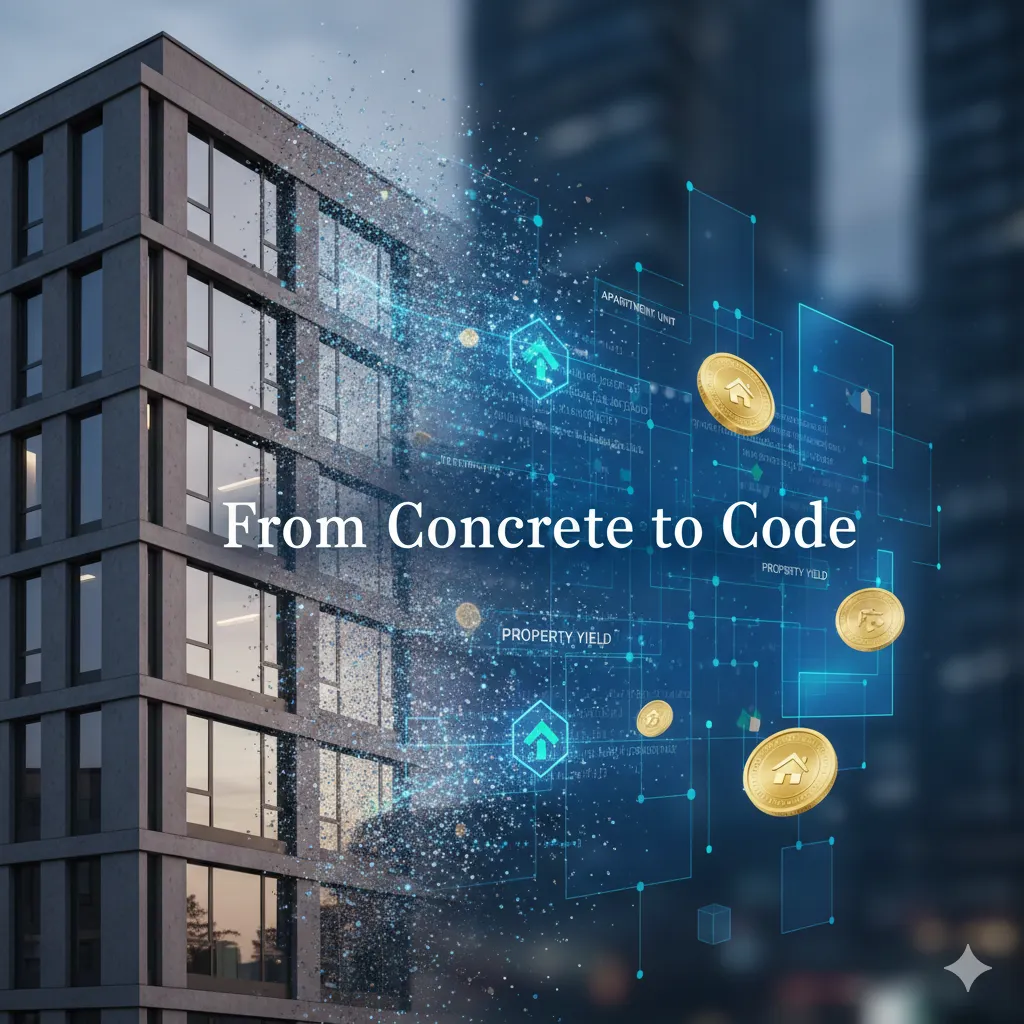
From “Concrete” to “Code”: what this changes for your model
Real estate tokenization is not a magical new asset class.
It is an infrastructure that is starting to redraw the boundaries between:
- traditional real estate
- finance
- Web3 technologies
Concretely, it:
- reduces the minimum ticket size for real estate investing
- makes it easier to circulate property rights
- makes the rules of the game more visible, because they are partly in the code
It also raises a tough question for many intermediaries:
if property becomes more liquid, which links in the chain need to reinvent themselves, and which ones will simply disappear?
And concretely, what should you do next?
Turning theory into action requires a simple plan.
From now on, a beginner investor can:
- Pick one project to dissect, not to buy. Go to a tokenization platform, pick a project and:
- read the legal documentation, not just the marketing page
- identify the structure (SPV, trust, other)
- check whether a standard like ERC‑3643 or ERC‑1400 is mentioned
- Check three points before any real investment. For each opportunity:
- legal structure: who owns the asset, and how exactly does the token link to it?
- technical standard of the token: is there a clear, recognized standard?
- secondary market: does it exist, is it regulated, what are the resale constraints?
- Define a “test ticket” to learn in the real world. Decide on an educational amount (for example €200–500) to:
- go through the full flow KYC → purchase → holding → income flows
- test the interface, reporting transparency, and support quality
- Write down what you learn. Note:
- what is smoother than in a traditional real estate deal
- what remains opaque or fragile
- what you will systematically require from future projects (standards, reporting, governance)
At this point, the real debate is no longer whether tokenization will exist in ten years. The real question is: how long are you willing to let your wealth sit trapped in paper while others are already learning to move from concrete to code?