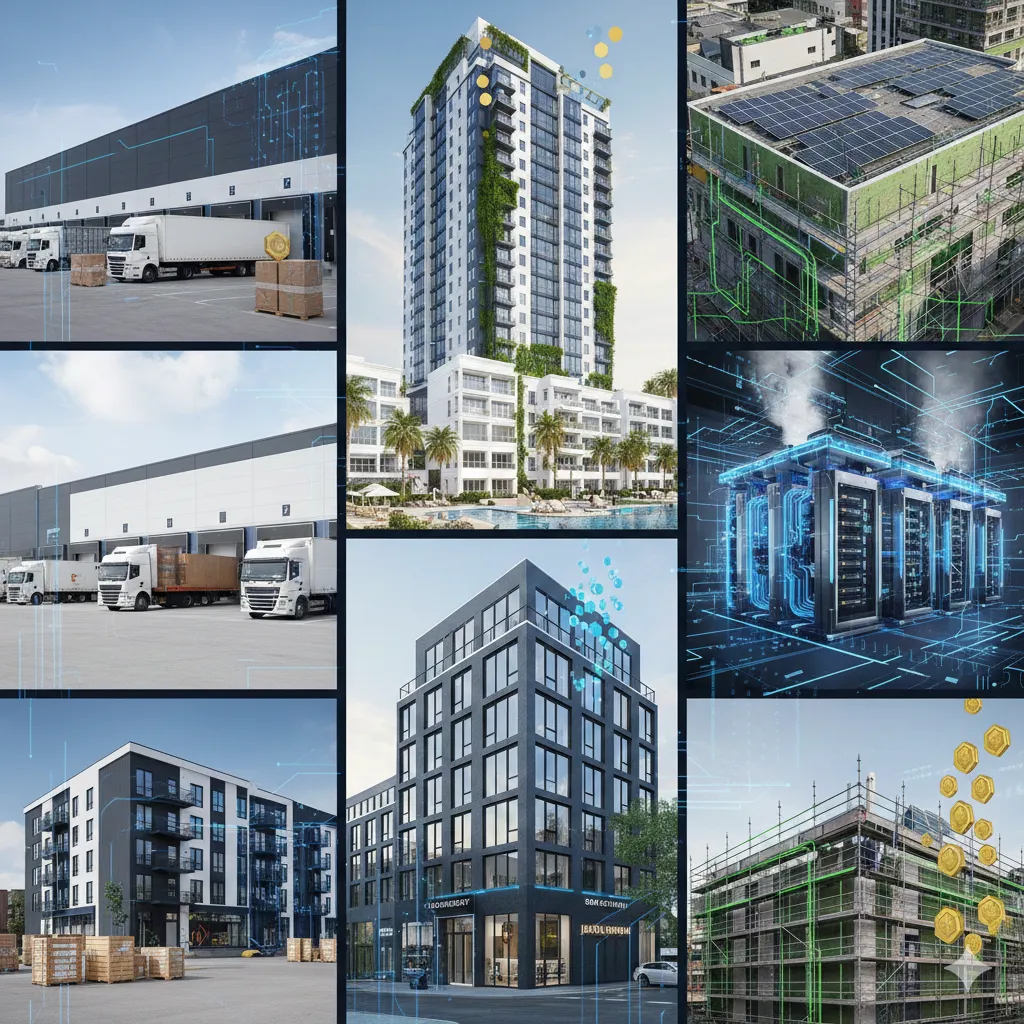
The rise of real estate tokenization is reshaping the investment landscape. While global real estate is worth close to $380 trillion, blockchain is opening new ways to make this asset class more liquid, more fractional, and more accessible.
Between 2025 and 2035, five segments clearly stand out as the best playgrounds for tokenization:
- logistics and e‑commerce warehouses
- institutional rental housing (BTR, multifamily)
- hotels and short‑term rentals
- data centers and digital infrastructure
- energy renovation (brown‑to‑green)
1. Logistics and e‑commerce warehouses: the most dynamic segment
A sector driven by structural demand
The logistics and e‑commerce warehouse sector is one of the strongest in the current cycle:
- supply chains are being re‑shored or diversified to reduce geopolitical risk
- e‑commerce keeps expanding, even in mature markets
- companies build more inventory and need more storage to protect operations
This leads to:
- very low vacancy rates in key hubs
- upward pressure on rents for modern, well‑located facilities
- rental flows that are relatively predictable over several years, often under long‑term leases
Why tokenization fits logistics so well
Logistics is a natural fit for tokenization:
- Attractive yields: often around 5–7% on good quality assets
- Risk spreading: a portfolio of warehouses can be sliced into tokens, giving investors exposure to several tenants and regions
- Programmable income: smart contracts can distribute net rents to token holders automatically, after predefined fees
For an investor, logistics tokens make it possible to access a historically institutional segment with smaller tickets, while benefiting from robust cash flows and strong structural demand.
2. Institutional rental housing: stability and recurring income
Why institutional housing is the defensive brick
Institutional rental housing (multifamily, Build‑to‑Rent) is the defensive core of many portfolios:
- chronic housing shortages in many large cities
- a growing share of households priced out of ownership, remaining long‑term renters
- high and stable occupancy rates, often above 95% in strong urban markets
This context generates cash flows that are:
- regular
- less cyclical than hotels or some commercial segments
- often indexed, providing some inflation protection
Tokenized housing: a solid yield engine
For tokenization, institutional housing offers:
- Visibility: 1–3 year leases, diversified across tens or hundreds of units
- Recurring income: monthly or quarterly distributions of tokenized rental income
- Geographic diversification: exposure to large residential assets in different cities and countries without buying whole apartments
Housing tokens are well suited for investors who want a steady income base with moderate volatility, similar to some residential REITs but with much lower entry tickets.
3. Hotels and short‑term rentals: the agile REIT of the future
A sector in rebound and transformation
The hotel and short‑term rental segment is experiencing a strong rebound:
- international tourism has returned, often above pre‑2020 levels
- premium destinations (Japan, Southern Europe, Gulf region) attract high‑spending visitors
- professionalization of short‑term rentals: portfolios of apartments are now managed like real estate products, not side hustles
“Branded residences” — apartments operated by luxury hotel brands — blur the line between lodging and hospitality, but strengthen pricing power and perceived value.
What tokenization changes for hospitality
Tokenization can turn hospitality into a kind of agile, global hotel REIT:
- Higher potential yields than traditional residential in premium locations, in exchange for more cyclical demand
- Programmable revenue sharing between operator and investors, encoded in smart contracts
- Targeted exposure: instead of buying a large listed group, investors can target specific assets or portfolios (ski resorts, seaside resorts, city centers)
For an investor, hotel tokens are more of a performance layer to add on top of a stable base (logistics, housing) than a defensive core holding.
4. Data centers and digital infrastructure: the techno‑strategic asset
Why data centers are exploding
Data centers have become one of the most coveted real estate assets in the age of AI and cloud computing:
- hyperscalers are investing heavily in capacity
- suitable sites combining land, connectivity, and power are increasingly scarce
- long‑term leases (10–15 years) with indexation provide strong visibility on future cash flows
The real bottlenecks are often:
- grid connection and available power
- local permits and regulation
- community and environmental constraints
Tokenizing data centers: opening up a previously closed market
Tokenization can:
- open capital‑intensive projects to smaller investors via fractionalization
- combine equity and debt in transparent, programmable structures
- give investors exposure to the growth of global digital infrastructure without relying solely on listed tech stocks
Tokenized data centers offer a dual exposure:
- real estate (yields, long leases, indexation)
- technology (structural growth in compute and storage demand)
Selection discipline is critical — operator quality, site fundamentals and legal structure matter — but this is one of the segments where tokenization can be truly transformative.
5. Energy renovation (brown‑to‑green): profitable impact investing
From ESG constraint to investment opportunity
Energy renovation is becoming a major axis of value creation:
- regulations tighten (energy performance, ESG reporting)
- inefficient assets risk becoming illiquid or heavily discounted
- public schemes and subsidies co‑finance part of the capex
A building successfully upgraded from “brown” to “green” can:
- avoid a significant discount
- benefit from stronger demand and better tenant perception
- reduce energy costs dramatically
What tokenization adds to brown‑to‑green
Tokenization can structure renovation projects as clear investment products:
- Targeted financing: equity or debt tokens dedicated to specific renovation projects or portfolios
- Transparency: energy savings and use of funds tracked on‑chain
- Combined return / impact: rental uplift and revaluation, plus potential carbon or ESG‑linked benefits
For investors, this brick provides a way to align:
- financial return
- preservation of underlying asset value
- and measurable environmental impact
How to approach these opportunities in practice
Platforms and products already operating
Several players are already experimenting with or deploying real‑estate tokenization across these segments. More important than the number of platforms is understanding:
- what asset you are actually funding
- how the legal structure works (SPV, rights of token holders)
- which rights you have as a token holder (income, information, governance, liquidity)
A minimal checklist before investing
Before taking a position in a real‑estate token, check at least:
- Regulation
- Is the token clearly treated as a security where appropriate?
- Is the platform supervised by a regulator?
- Quality of the underlying asset
- Location, tenants, lease terms, historical occupancy.
- Governance
- Who decides on capex, refinancing, and exit?
- How are conflicts of interest managed?
- Liquidity
- Is there a real secondary market, with actual buyers and sellers?
- Are there market makers or other mechanisms to support trading?
- Fees
- What are the entry, management, performance and transaction fees?
- How do they compare to a traditional REIT or private fund?
The decade of real‑estate tokenization
The 2025–2035 period has all the ingredients of a decade of gradual adoption for real‑estate tokenization:
- regulatory frameworks are maturing
- technical building blocks are stabilizing
- real, concrete use cases (logistics, housing, data centers, ESG) are emerging
Tokenization does not replace traditional real estate. It unlocks what was previously hard to access: fractionality, liquidity, programmability.
The key question is no longer “Will tokenization exist?”, but rather:
On which specific segments does tokenization already offer, here and now, a better mix of transparency, liquidity and access than traditional vehicles?
That is where the true playground lies for serious investors.